In most people’s lives, moving into a new space can be both intimidating and exciting. Whether it’s moving into a new home as a child, into a dorm or even moving someone else into one’s own space, the journey taken and lived is a unique yet universal experience. As people move from place to place, there will be some things they leave behind, such as forgotten jewelry or books, and some things they will never truly part with, like a family heirloom or even a beloved stuffed toy. In Unpacking, a relaxing story/puzzle game developed by Witch Beam, the player is tasked with unpacking multiple boxes of the main character’s belongings as she moves into new spaces—ensuring everything goes into the perfect spot.
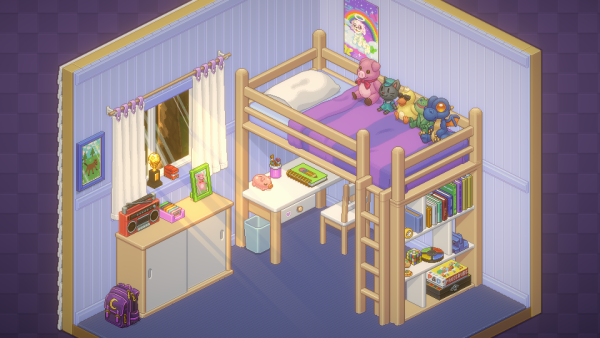
It starts in a small bedroom in 1997. The walls are a light blue and the short carpet is purple. There’s a small cabinet tucked beneath a window that looks out into a backyard, next to the desk of a loft bed pushed against a corner of the room, with pink-and-purple striped sheets. Finally, in the middle of the room, there are three big, cardboard boxes. From them, the player pulls out lots of items, such as books, toys, a soccer trophy, a cassette player, a piggy bank, a dreidel and a big purple backpack. There’s a framed drawing of a horse in front of a few trees, seemingly drawn by a child and another—except instead of a horse, it is a pig with a red bowtie in front of an open field. This is later revealed to be not just any random drawing, but one of the stuffed toys within the boxes: a brightly-colored pink pig with chubby cheeks and a perfectly tied red bow around its neck.
The room undoubtedly belongs to a child, and the pig most certainly holds a special place in that child’s heart. When the level is completed, a camera snaps a photo of the room and the image is moved into a scrapbook with the words “Finally, my own room!” written below. By unpacking just three boxes for one small room, it is learned that the main character is a young Jewish child, likely a girl based on all the pink and toy ponies, with a deep love for her stuffed pig and art.
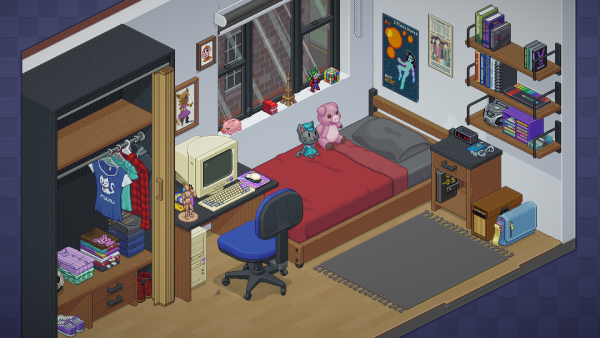
Fast forward seven years to 2004 to yet another bedroom, though this time it’s bigger. There’s a twin bed with red and black sheets pushed up against a wall right next to a large window with an excellent view—of the neighboring building’s brick wall. Next to the bed is a dark gray fringe rug and a small nightstand with three shelves on the wall above it. Meanwhile, at the foot of the bed, is an empty desk with a blue office chair with a wardrobe next to it, containing nothing but a few clothing hangers. On top of the rug is a pile of seven boxes and a chunky computer. A few different things are unpacked, like clothes, a keyboard, a CD boombox and more art paraphernalia—pencils, markers, a posing mannequin and some framed drawings—as well as books, including art books. The stuffed pig also returns, missing its red bowtie, but otherwise just as vibrant as before.
There are a few other rooms for the player to explore and unpack, such as a tiny bathroom and an equally tiny kitchen. Despite their size, however, it never feels like the main character is trying to “cram” herself into the space—it feels as though it’s a perfect fit for what she currently owns and cherishes.
The level strongly resembles a college dorm room, and once the level is completed and a picture is taken of the bedroom, it goes right into the main character’s scrapbook, with “Classes start Monday! Uni, here I come!” written below, confirming that the resemblance is no mistake. The main character has grown up and is now attending university, with the art books and materials in their room suggesting a major in the arts.
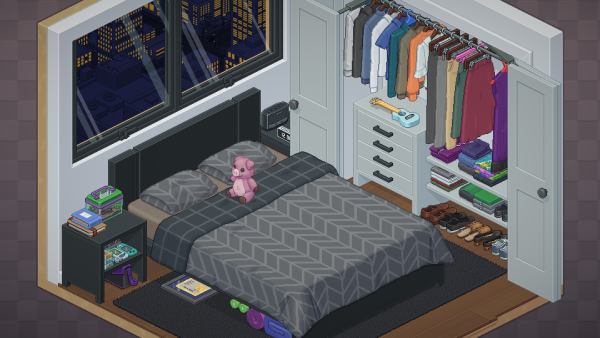
Skipping a level and a few years to 2010, the main character moves into what appears to be a man’s apartment—presumably her boyfriend’s. Every room shares the same color palette, black-and-white, with minimal decorations and furniture. Despite the lack of “personality” within the rooms and the seeming plethora of space, the player finds that there is barely any space for the main character to move her own belongings into. Her stuffed pig remains, however, though it now appears duller in color and has two rips—one on its stomach and the other on the back of its head. Throughout the level, the player is likely struggling to find where the main character’s diploma will fit. There’s no space on the walls in the living room, the kitchen, and hanging it above the toilet is just degrading.
So, with no wall space even in the bedroom, the main character is forced to tuck her diploma, her greatest achievement, underneath the bed. Kylee Pollitt, an SSU student who has completed a full playthrough of Unpacking, said: “The level was honestly a lot harder than the other ones, and the colors of the room and items just made it feel so dull—and the diploma just made me sad.” Once the level is completed, emphasizing the players’ difficulty in finding space for everything, a picture of the bedroom is taken and tucked into the main character’s scrapbook with “Barely managed to fit myself in here!” written below it. It makes the player wonder whether the boyfriend is considerate of the main character’s needs.
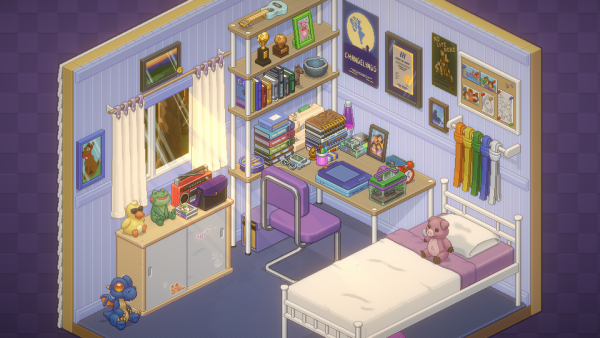
Just two years later to 2012, the player is taken back to a rather familiar location—the main character’s childhood bedroom. The old loft bed was since replaced with a normal twin bed and a new desk with a big shelf on the side of it, though the cabinet beneath the window remains, in addition to some of the main character’s old belongings such as her cassette player, stuffed toys and trophies. It appears that she and her boyfriend have split apart, which is confirmed when the player tries to pin a picture of her and a man on a corkboard above the bed, where the main character places the pin right in his face.
The player unpacks lots of books, art supplies and other belongings that the main character brought with her—including the stuffed pig yet again, which somehow appears even duller with the same rips in its stomach and the back of its head. When the level is completed and the player takes a picture of the room, the text is missing the main character’s usual upbeat and positive message, merely having “This room used to feel bigger” written beneath it.
Then, one year later, it is 2013. The player finds they are inside a new location—seemingly an apartment of the main character’s own. There are the usual rooms to unpack, such as the kitchen, living room, bedroom and now also an office. The walls are an orange brick, in addition to the occasional white wall with tiny patches of the wallpaper missing and the floor is a richly colored wood. There is a big desk next to an equally big window and next to this same window is a smaller shelf and a metal cabinet.
In this office, the main character may finally proudly display her diploma on the wall among multiple pieces that appear to be her own original artworks—the same one she was previously forced to tuck beneath a bed by her ex-partner. The shelf is loaded with lots of sketchbooks and art books, as well as a few art materials. Then, on her desk, there is the main character’s laptop with a smaller drawing tablet, as well as a tabletop easel. Her stuffed pig may also be placed within the room, with its vibrant pink back and the rip on its belly now repaired with a small pink patch sewn over it. An SSU student with a minor in fine arts, who wished to remain unnamed, stated: “I really love how the pig kind of portrays to the player how the main character is feeling, like how the washed colors and tearing show she’s going through a rough time, while the repairs show she’s healing from said rough time.”
Once this level is finally complete, the player may take yet another picture for the main character’s scrapbook, her upbeat tone finally returning as she writes, “Making this my art space!”
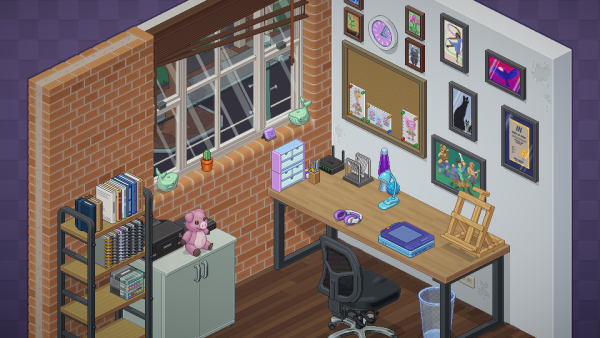
Two more years later, in 2015, the player finds themself back at the same level. Greeted with the same brick walls, wood floors and the main characters’ belongings, but when the boxes are unpacked, to those who pay attention to the main character’s personality and interests, it is easy to notice that these do not appear to be her own items. Instead of the items communicating an interest in the visual arts, these new belongings appear to belong to someone who has an interest more in the performing arts, particularly movies. Additionally, there is also a new addition to the main character’s stuffed pig—a colorful stuffed tiger with a yellow shirt that can sit right next to it.
Upon completing the level, as with any of them, a picture can be taken of any room. Most rooms inspire comments on the appreciation for more belongings being added—such as the main character stating it feels more like a home, or that they are grateful for all the extra space. But when a picture is taken of her office specifically, the player gains more information on how her art career is going—she has a ribbon, what appears to be a glass trophy and even more art supplies alongside a new computer. There are also new drawings on her corkboard of even more of her artwork, most importantly featuring a pig in brown overalls. Once a picture is taken and added to her scrapbook, the main character writes, “It’s been hard but I’m starting to get somewhere!”
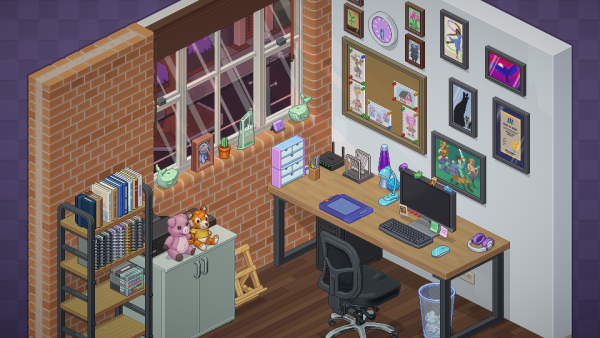
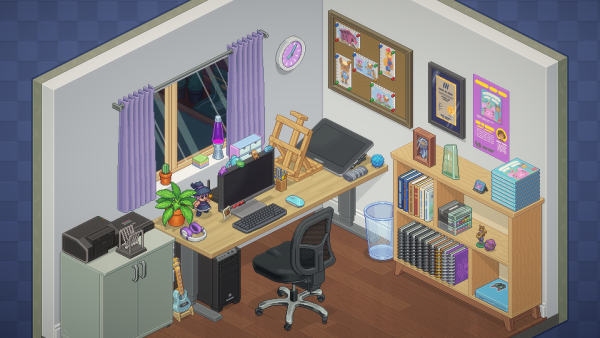
Finally, three years later, it is 2018. The main character, alongside her partner, have both moved into a “real” home—one that is completely their own, with no upstairs or downstairs neighbors and one where budget was certainly not much of an issue. The player goes through the home, unpacking all of their belongings that seem to be in perfect harmony with one another, everything fitting as if the house were made for them specifically. The player eventually comes across the office—the boxes begin with what most would expect, such as the main character’s computer, decorations and even a hugely upgraded drawing tablet—literally.
But then, the player will pull out something familiar, yet something they have never seen before—a book with the main character’s pig on the cover. Then another. And another and another. They pull out seven copies of the same book, then sticky notes with the pig and even a poster with an image of the book with the main character’s face. Her art career has finally taken off, publishing what is likely a children’s book.
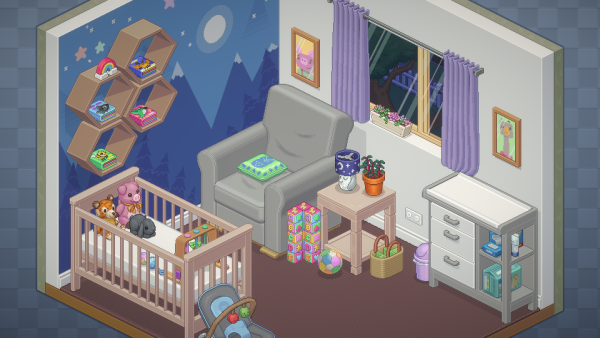
With this great achievement, the player may expect this to be the big end of the story—a successful art career that has only just begun. But when they move to the last room, they see that is not the case; it is a nursery. The main character and her wife are introducing a new person to their family, and the room is clearly decorated and constructed with love—there is a wall with mountains in the night painted on it, with a plethora of baby toys and books scattered about.
There are also framed drawings of characters from the main characters’ children’s book, with an overall cozy and warm atmosphere. Inside the crib, it can be seen that the main character and her wife have gifted their future child their own childhood plushies—the wife’s stuffed tiger, and the main character’s stuffed pig, which now dons a yellow ribbon tied around its neck, matching the tiger’s yellow shirt. There’s now a third plush toy as well—a small black rabbit with its ears down. An SSU game and simulation arts major, who wished to remain unnamed, stated: “I like that they put another stuffed animal with the two stuffed animals to represent the main character and her wife, and the baby they have together.” He is one of the many players who picked up on the plushes being representative of the main character, her partner and now even their baby—it is a growing collection of sentimental belongings, just as they are a growing family.
When a picture is finally taken of the nursery and the final level concludes, the main character writes, “We’re so looking forward to meeting you!”
After that, the game finally concludes with one last image: the main character and her wife sitting in their backyard with the main character wearing her sunhat with a blue ribbon, a white blouse, and a green skirt with white flowers playing her ukulele. Next to her is her wife in a red and white strawberry dress, holding their new baby as they watch the sunset—the sky a gradient of pink and orange, casting a warm glow on the family. The main character writes her last note in her scrapbook, likely addressed to both the player and her family: “Thanks for joining me on this journey.”
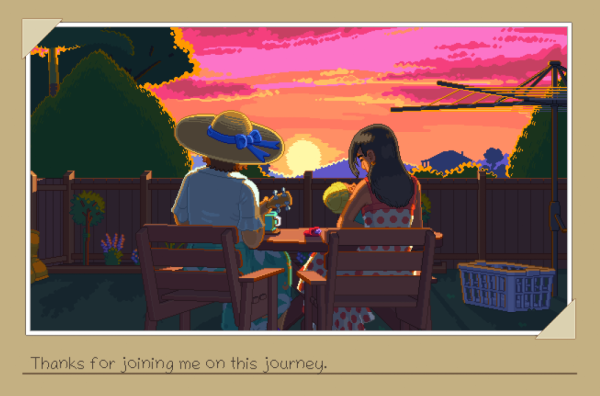
All images are screenshots from the author’s own gameplay. “Unpacking” was developed by Witch Beam and published by Humble Bundle in 2021.