Procrastination is something that most people have struggled with—whether it is something as simple as waiting a little bit longer than they intended to start buying Christmas presents or waiting until the day before a very important and complex assignment is due to finally start. While most simply write this behavior off as just someone (or even themself) being lazy, sometimes there can be more to the story, too.
So, if not for just plain laziness alone, why would someone procrastinate? What are some other reasons that people may “choose” to do so? Self-proclaimed procrastinator and Shawnee State University student Hope Jenkins responded to this question.
“I don’t think it’s a choice for me,” she said. “I think about starting something, then I either get so distracted or overwhelmed that I just don’t do it and put it off for later. That, or my awful sense of time makes it so I feel like I have more time to complete something than I actually do. Then I get to the point where I don’t have a lot of time and I’m panicking and rushing to get it done.”
Clinical psychologist Jacqueline Sperling, Ph.D., lists these same reasons as well as others, such as simply feeling bored or, like Hope experiences, getting distracted. Nobody wants to do something they find no joy or entertainment in, and in today’s world where technology and social media are everywhere, offering something much more enticing than writing a report is bound to distract or pull someone away from their chores or other duties.
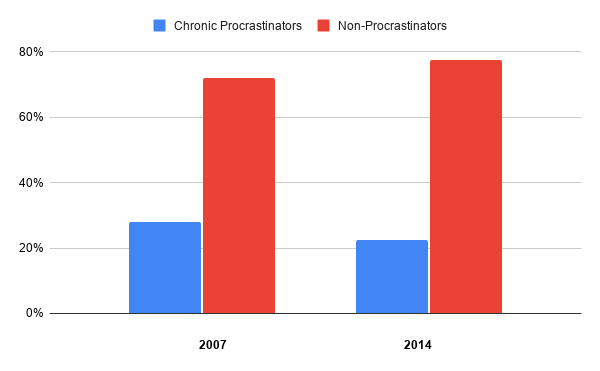
However, it is to be noted that procrastination is not always caused by social media or technology. Sperling mentioned how “procrastination has been reported as a human behavior throughout history” and is nothing new, though there has been some research that points to an increase in the levels of procrastination in recent years. When looking at available data from a study on how many people (from different nations, not just the U.S.) are chronic procrastinators in 2007, compared to a similar study addressing later numbers in 2014 (long after social media “took off”), they actually appear to yield similar results. Though it is to be noted that in-depth research on procrastination and efforts to stop it are more recent, as psychology professor Joseph Ferrari, Ph.D., stated, “For years, people did not see chronic procrastination as a serious issue,” so some results may not be truly representative of “real” statistics.
More reasons someone may anticipate as being a cause for procrastinating include feeling fear and anxiety regarding the task or duty—another “reason” Hope listed for why she may procrastinate. While these are particularly broad reasons and can cover lots of different points without saying much, Sperling provided an example, stating, “You might delay essential medical tests because you’re afraid of a diagnosis. The more anxiety we experience about a task, the more likely we’ll put it off until later.” Though the fear or anxiety may be from something less important to one’s physical health, such as social anxiety or a lack of belief in their own abilities and perfectionism. Nobody wants to be judged or embarrassed by strangers or people they know, so if someone believes or fears they cannot efficiently and effectively complete a task, they would be very easily inclined to put off starting, continuing or finishing that task.
Additionally, referring back to Sperling’s example of delaying medical tests, it shows that procrastination can, in some extreme cases, lead to health risks. Though most effects of procrastination tend to be something much more tame, though still undesirable, such as missed deadlines or delayed goals. Another self-proclaimed procrastinator, “Zach” (name changed for privacy), shared a time they procrastinated and the effects it had on them.
“One year, I procrastinated on my high school English class’s final for so long that I had to finish it while I was on vacation in Puerto Rico. I spent a third of my time there writing an essay.” Zach mentioned regretting waiting so long to begin writing their paper, as it resulted in them being unable to fully enjoy their short vacation. Hope also shared a short story about a time she procrastinated, which can be heard below:
Meanwhile, another SSU student, Kylee Pollitt, describes herself as a non-procrastinator. She explained how it was not a “natural” habit of hers to get things done in a timely manner, but rather a discipline she had to learn. A small piece of advice she suggests for procrastinators is to try thinking about the bigger picture: “Try to imagine how much less stressed you would be without the mountains of paperwork and homework.” What she means by this is to think about the long-term benefits instead of the short-term benefits—weighing the pros and cons of getting some work “over with” instead of putting it off for later and thinking of the stress that would cause, can be enough to motivate some individuals to start.
Some other ways to combat procrastination include eliminating distractions (putting devices on silent) and rewarding yourself, according to CollegeData. While eliminating distractions is a common piece of advice and one that is self-explanatory, rewarding yourself means giving yourself a gift or “prize” for doing one’s work/completing their task(s). It can be something as simple as having a small treat or taking a nap—anything that feels genuinely rewarding. The Cleveland Clinic restates this same advice to minimize distractions and rewarding yourself, but they also suggest breaking down bigger tasks into smaller, more manageable ones—as it is much easier to convince oneself to do just one quick household chore rather than to clean the entire house all at once. Additionally, it is suggested to schedule breaks to prevent burnout and exhaustion, as well as to use other time management techniques. Some of these include, but are not limited to: creating a to-do list, setting a timer for tasks/breaks and scheduling more “demanding” tasks during times you know you will likely be more energetic or motivated. The main takeaway is to always be kind and patient with oneself, while also not being too lenient. Getting rid of a habit, especially one like procrastination, is much harder than it may seem at first glance—but it is far from impossible.