On April 1, 2026, at 6:35 p.m., the Artemis II, crewed by Reid Wiseman, Victor Glover, Christina Koch and Jeremy Hansen, took off from the Kennedy Space Center in Florida. For the first time since 1972, millions gathered to watch a manned spacecraft take flight en route to fly around the moon.
Here in Portsmouth, at Shawnee’s Clark Planetarium, students and staff gathered to watch the launch on the big screen. The launch was a historic landmark for the United States for many reasons. The crew was made up of firsts in lunar missions – Glover was the first person of color, Koch was the first woman, Hansen the first non-U.S. citizen and Wiseman the oldest. The trip also broke the Apollo 13’s record for human distance from earth by 4,101 miles. The watch party, hosted by SSU professor Tim Hamilton, provided a common space for viewers to watch the launch in a larger-than-life setting. A watch party was also held for the re-entry and splashdown of the crew on April 11. Around 15 people attended the launch watch party, and five attended the second watch party for Artemis’ re-entry.
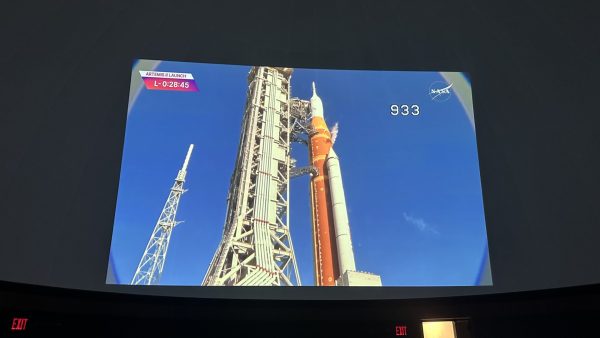
“I was a baby when the last two Apollo missions landed on the Moon,” Hamilton explained. “My parents tell me I did watch them, but I was too young to know what was going on, and of course I don’t remember anything.”
For all of Hamilton’s life, he read and watched the historic manned moon landings, never thinking he’d get to experience it with any real awareness. He was always interested in spaceflight and even developed an Apollo mission simulator for his physics classes. “In building this, I’ve read lots of NASA documents that describe how the equipment and procedures worked, and I had this expectation that watching Artemis fly was going to feel fairly routine as a result. It wasn’t.”
Before Hamilton became a physics professor at Shawnee State University, he worked at NASA. He had a friend in his building – a young engineer named Christina Koch, who he would often have lunch with. “She was part of a group of us who’d get together socially at the end of the day. After I left and came here to teach, she went into the astronaut corps and was eventually selected for Artemis II and became the first woman to the moon – or at least around the moon.”
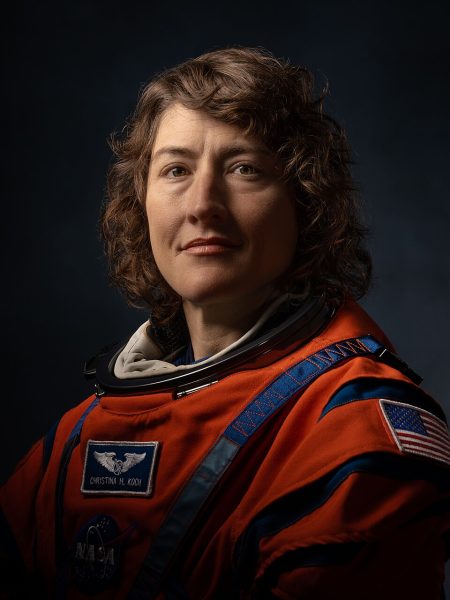
“It’s a strange feeling to know somebody who is out there taking those risks and experiencing it firsthand,” he explained.
Hamilton shared that he and his friends were still nervous about the Artemis’ heat shield holding up on re-entry; the unmanned flight of Artemis I showed unexpected pitting of the shield that could have been dangerous. NASA had changed the Artemis II’s flight pattern to account for the issue, but it hadn’t been flight tested before the manned mission. Luckily, after a six-minute radio blackout, the astronaut’s voices came through once again, which was a big relief for Hamilton. The blackout had been caused by the plasma heating up the heat shield, but everything went smoothly.
“The community feeling of watching together is really different from experiencing it alone,” Hamilton recalled. “I think it has something to do with knowing that the others there are enjoying it the way you are, and that feeling gets reinforced. The launch watch party at the planetarium had that murmur of excitement running through it as the countdown approached zero and the engines lit.”
Hamilton was at an astronomy conference in Cincinnati at the time of the Artemis II’s re-entry and splashdown. The conference attendees gathered at the Cincinnati Observatory to watch the event. Among them were people with backgrounds in space programs – Hamilton had experience with the Hubble and James Webb space telescopes, another attendee used the Swift space telescope and yet another had worked on Orbiter operations for the space shuttle’s first 33 missions. “Despite this experience, or maybe because of it, we still felt a thrill at seeing this re-entry from the moon – the infrared tracking images of the spacecraft, glowing hot from the hypersonic flight through the air, the parachutes deploying and the big splash as it hit the water safely.”
Two attendees of the Artemis II’s launch watch party – professor Paul Yost and student Joslynn Beneke – described the launch as personally meaningful.
“This mission stands as a defiant reminder of what humanity is truly capable of when we are at our best,” said Yost. “It shows what talented and dedicated people can do when they choose to dream, to build, to explore and to push knowledge forward together.”
Beneke has always loved space and had dreams of being an astronaut, so the Artemis II mission was personal to her. “Watching Christina Koch as a mission specialist, knowing she was on a path to become the first woman on the moon, is incredibly powerful and inspiring. Not to mention her incredible journey to get there, from growing up on a small family farm like mine to all of her successful journeys and research trips.”
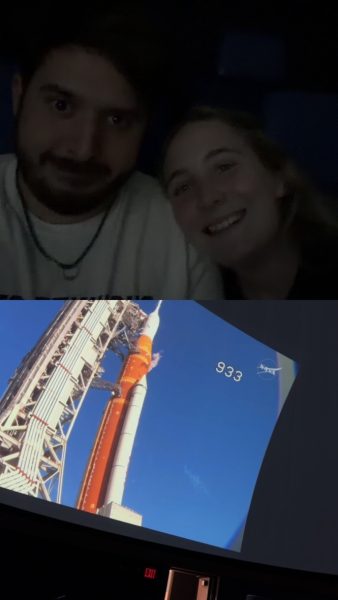
The watch party connected those in attendance, creating a sense of togetherness and unification. “It truly felt like witnessing history in the making,” Yost recalled. “The Apollo missions are now so far in the past that many generations don’t have crewed spaceflight as a cultural touchpoint. Hopefully, this marks the beginning of re-establishing that connection – and that these missions will inspire the next generation.”
Yost also shared that he felt a strong nervousness leading up to the launch, then relief once it had succeeded. “The space shuttle Challenger disaster left a lasting impression on me when I was younger, and I’m not sure I’ll ever be able to watch a crewed launch without some level of anxiety.”
Beneke remembered everyone watching the launch in awe, the excitement palpable in the room. “When we reached the final countdown, an eerie silence took over the room – and when it launched successfully, nobody cheered for a few minutes. We were all mouth agape with shock and awe. I cried; it was overwhelming in the best way.”
The wave of emotion that came after the launch was a significant moment for Yost. “It’s truly remarkable what we’ve been able to accomplish with science and technology,” he said.
“Just about 120 years ago, we were learning to fly using bicycle parts, wood and canvas. Now we’ve built a machine weighing 5.7 million pounds that can lift off the ground and carry people farther from Earth than any human has ever been. How incredible is that? It gives me hope for humanity.”
Yost also mentioned that NASA is a customer and user of sensors that he designed, including some custom development work at his company, Yost Labs, Inc. “I couldn’t help but feel that I may have played a small part in supporting their mission preparation,” he said.
For Beneke, seeing Christina Koch problem-solve in real time was inspiring and substantial. Shortly after the launch of Artemis II, the spacecraft toilet – of all things – began having issues. Koch performed a repair during the flight, guided by mission control, dubbing herself the “space plumber.”
“It made everything feel real and human,” Beneke said. “Not to mention incredibly empowering, watching her be the person everyone looked to when each problem arose, and how she worked through everything and made sure they were successful.”
Beneke shares the sentiment of witnessing history with Yost. “The moment of liftoff itself, knowing it was successful on the first try, was amazing and is something I’ll never forget.”
The launch of the Artemis II marks a turning point in space exploration for the United States. Not only was the crew diverse and inspiring, but the flight broke records and opened up the possibility of longer, more sustained lunar exploration. The event gave rise to the term “moon joy,” which refers to “the feeling of intense happiness and excitement that only comes from a mission to the moon,” as described in a tweet by NASA.
Yost put it best: “At a time when division feels constant, misinformation and propaganda run rampant, and anti-science, anti-intellectual voices are growing ever louder, this mission stands in stark contrast. To me, Artemis II is a clear, hopeful signal that we don’t have to move backward. We can still choose curiosity over fear, progress over cynicism, and a future shaped by reason, discovery and shared purpose.”