When Lakota walks in the hospital lobby with her purple-colored tail wagging, people turn and smile. She dutifully trots on her leash next to her handler, but her mismatched eyes (one blue and one brown) look for someone to comfort and love. Maybe Lakota’s search for human attention is a trait in most dogs, or maybe it is something specifically trained into dogs whose job it is to comfort people.
Lakota is one of the therapy dogs that work in UK Kings Daughters Medical Center in Ashland, Kentucky. She is a husky whose job is to bring staff, patients and visitors comfort in difficult times. Before Lakota became a therapy dog, her owner, Renea Savage Brown, noticed that Lakota naturally comforted people and made their day better.
“People would constantly want to come up and pet her, and she was really receptive to that, and I saw their reactions to that,” Brown said. “And I know how she makes me feel, you know, being my dog, and I was like, ‘Oh I need to share this with the community.’”
Brown also noticed how much Lakota enjoyed helping people feel better, and how it matched her dog’s personality. She decided that she couldn’t keep Lakota’s happiness to herself.
From there, Brown went on to get the correct certifications for Lakota to become a therapy dog. Amie Schwendeman, the manager of volunteer services at King’s Daughters, said, “The certification process is separate from a volunteer role in the hospital. The certification is through an organization that is nationally recognized.” There are a multitude of qualifications that Lakota had to meet to become a therapy dog, which include being well-mannered, obedient, comfortable around medical equipment and enjoying being around people.
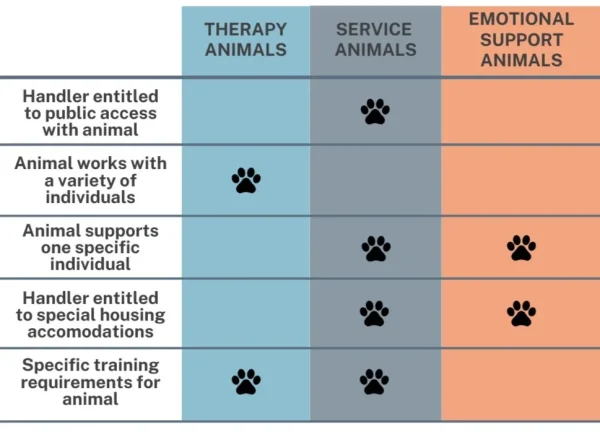
A frequent misconception about Lakota and dogs like her is that she is a service or emotional support animal. In fact, she is actually a therapy dog. These animals are trained to give comfort to people in a variety of settings, such as hospitals, dentist offices, mental health clinics and more.
“Therapy dogs, same thing, except these dogs are trained to be calm in public, good with other people, good around the medical equipment, but they are not task-oriented,” Brown said.
Therapy dogs’ jobs are to promote calmness and happiness in multiple people. Service dogs are trained for specific tasks to help people with disabilities, such as mobility difficulties or medical alerts.
The impact that Lakota has on people is clear to see. While I was meeting her, patients, staff and visitors would smile and stop to pet her. People who were once walking quickly to get somewhere paused to gush over her colored tail and ears, pat her on the head or scratch her back. The tone of any room she entered became more positive and calm.
Lakota has helped countless people, but there is one interaction that sticks out in Brown’s mind. One evening, Brown received a phone call from a police department. A minor was being brought into the hospital by the police to be evaluated because she did not have her guardian with her, and she was requesting to see a dog. Brown said that “Lakota’s never, like, pulled me in a room; she pulled me in that room because she knew that little girl needed her. She went in there and sat right by that little girl’s bed and let that little girl love on her for quite a while. She didn’t move, she didn’t care, she just wanted to be with that little girl.”
Since that interaction, Brown has established a relationship with the local police so that Lakota can continue to help people outside of the hospital.
After seeing therapy dogs in action, there is no question why they have been rising in popularity in recent years. Zac Nance, an assistant professor of psychology at Shawnee State University, stated, “I feel that it is a combination of the growing supportive research and the need for innovation in addressing the ‘mental health crisis.’ Animal-assisted strategies also blend well with most modern theoretical approaches.”
After the COVID pandemic, many people’s mental health was poor, which meant that the way these issues are addressed had to be changed. Therapy dogs like Lakota are a way to support people in difficult times. .
As my time with Lakota came to a close and someone else stopped to scratch her head, I realized how amazing it is that she has no clue what she means to people. She brightens any room she walks into and helps numerous people, and she does it effortlessly and without thinking. Therapy dogs mean everything to the people they meet, and Lakota is no exception.